
Portfolio management
Monitor holdings, cash, weights, benchmarks and exposures across portfolios from one consistent view.
Fund managers
Manage portfolio data, investment decisions, risk and controls consistently across strategies, accounts and mandates.
For investment teams, portfolio oversight and operations across mandates.
The operating reality
An investment idea may be shared across strategies, but implementing it is portfolio-specific. Cash differs. Benchmarks differ. One account has a restriction, another already carries the exposure. A model weight is only the beginning of the decision.
The operational burden grows when portfolio managers, risk and operations work from different extracts. Your team needs to carry an investment view through each account’s constraints and explain the resulting changes without rebuilding the analysis in spreadsheets.
How does the same investment decision affect each mandate, account and set of constraints?
Built for your team
Monitor holdings, cash, weights, benchmarks and exposures across portfolios from one consistent view.
Model changes before implementation and understand their effect across portfolios and accounts.
Apply portfolio limits, mandate rules and risk analysis before proposed changes become positions.
Keep instruments, positions, benchmarks and portfolio analytics aligned across investment and operational workflows.
A workflow in practice
An illustrative workflow: a team changes a target allocation. Each portfolio is reviewed against its own holdings, available cash and configured constraints before proposed orders are handed off.
Bring the research, portfolio objective and proposed allocation into a common review.
OneBook · Data GatewayReview current holdings, cash, benchmark exposure and the constraints relevant to each account.
OneBookCompare current and target weights, turnover and cash impact before implementation.
OneBookKeep the proposal and its review context available to investment, risk and operations teams.
OneBook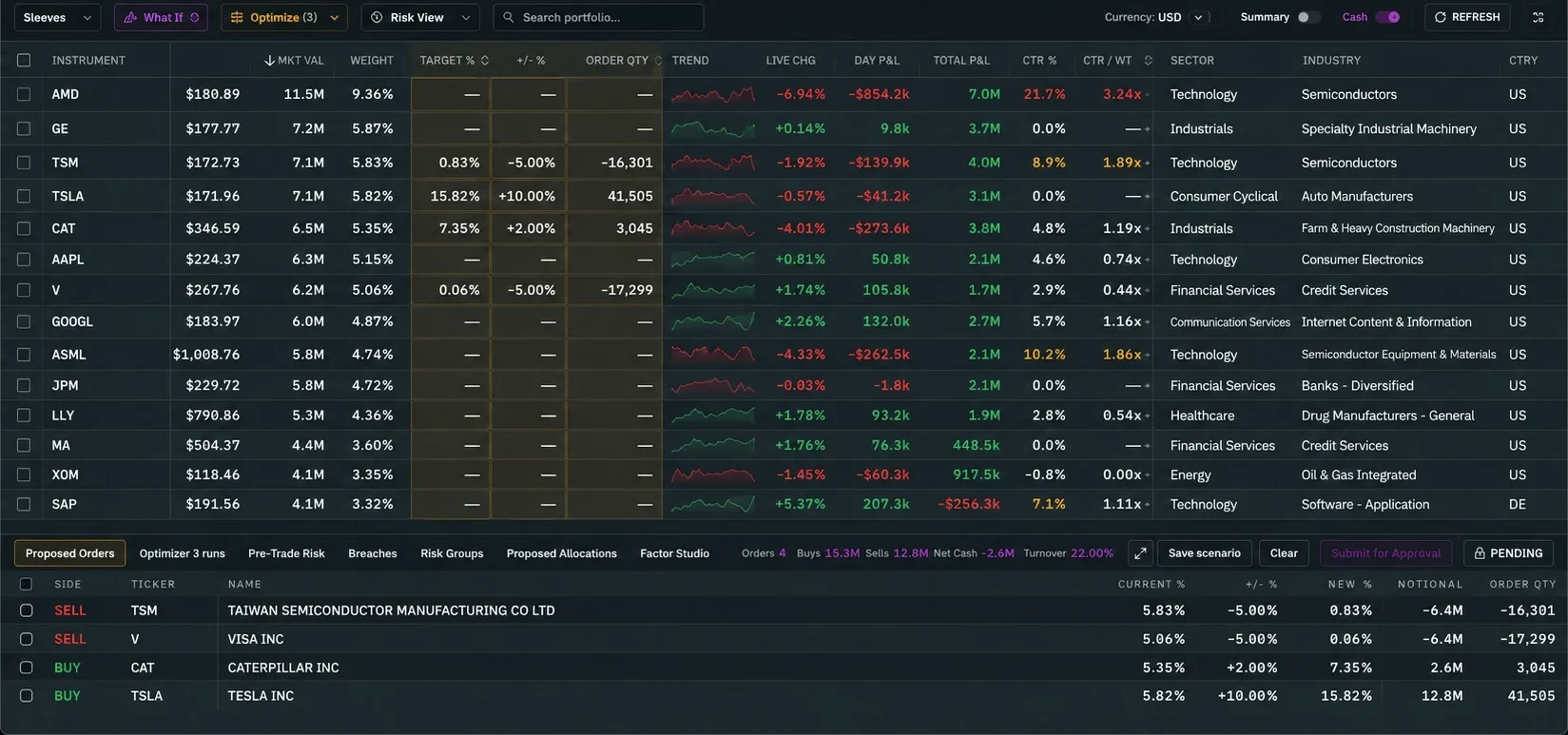
See how a proposed change affects holdings, cash, turnover, restrictions and risk before implementation.
How it fits your stack
QuantJourney can provide portfolio management, IBOR and risk capabilities directly or connect to existing order management, custody, accounting and reporting systems.
You do not need to replace the entire investment stack to improve it.
Establish a consistent portfolio management, IBOR and risk workflow. Begin with a representative strategy or group of portfolios and expand the agreed scope.
Connect existing order management, custody, accounting and reporting systems. Map portfolio identifiers, benchmarks and update cadence before relying on the combined view.
Align deployment and access with your investment and operational teams. Confirm the data boundary, permissions and support responsibilities during evaluation.
Yes. A representative set of portfolios helps establish data mappings, required controls and the review workflow. Additional accounts and strategies can be scoped once that foundation has been validated.
Required rules are reviewed with your team and mapped to available controls and configuration. Coverage must be confirmed for your instruments, mandates and workflow; your firm retains responsibility for policy interpretation and approvals.
Yes. The integration can preserve those systems as authoritative for their respective records. We define how positions, cash, instruments and portfolio analytics are exchanged, and how differences are identified and handled.
Choose a recurring decision such as a rebalance or a model change. Describe the portfolios involved, their constraints and the handoff to operations. Illustrative data is sufficient to start; connectivity and rule coverage are confirmed separately.
Start with one workflow, its source systems and the data it needs. We agree mappings, responsibilities and evaluation criteria before introducing live data. Existing systems can remain authoritative while the new workflow is validated; any migration is scoped separately.
Pricing depends on the selected products, data entitlements, integration scope and deployment. The open-source Backtester engine is available under Apache 2.0; managed data, PRO tooling and private deployments are evaluated separately. We establish the requirements before proposing a commercial scope.
Start the conversation
A shared investment view still has to work across different portfolios, mandates and controls. Tell us where the friction sits — portfolio data, rebalancing, risk or the handoff to operations. We will start with that workflow and the systems your team already relies on.
Start with a description of the workflow. Please do not submit confidential holdings, client information or access credentials.
Required fields are marked with an asterisk.
We will review your workflow and reply to discuss the next step.
Return to QuantJourney