AuditService: Designing Compliance‑Grade Audit Logs for Proprietary & Institutional Trading Funds
Audit records, retention and traceability for institutional investment infrastructure.
Introduction: Why AuditService Matters
Building AI trading models is tough - don’t let compliance slow you down. At QuantJourney, we’re creating a B2B Framework for proprietary trading firms, family offices, and institutional funds, with AI-driven trading at the core. Our AuditService ensures your algo trades meet global regulatory standards (SEC, CFTC, MiFID II, FINRA) without bottlenecking your ML pipelines. From logging model predictions to streamlining audits, AuditService lets you focus on alpha, not paperwork.
This post shows how AuditService integrates with AI trading workflows, delivers tamper-proof logs, and saves time and costs.
Why AI Investors and Quants Need AuditService
Regulatory compliance is non-negotiable in institutional trading, but it shouldn’t derail your AI innovation. AuditService bridges the gap by:
Logging AI Outputs: AuditService captures every AI model prediction, feature input, and trade decision with millisecond precision, ensuring compliance with MiFID II’s nanosecond-level requirements without slowing down your ML pipeline.
Supporting Black-Box Models: For complex models, AuditService logs explainability outputs (e.g., SHAP values, feature importance) in a tamper-proof format, satisfying regulators and streamlining post-mortems.
Enabling Fast Audits: With 50ms query times and a replay() function, AuditService reconstructs trading sessions in under an hour, cutting audit prep time by up to 50%.
Case Study: An investment team deploying a reinforcement learning model for high-frequency trading used AuditService to log model decisions and trade executions. When regulators requested a 72-hour reconstruction of a trading session, the team used AuditService’s replay() function to deliver a compliant report in under an hour, avoiding costly delays.
Key Technical Terms Explained
To make AuditService accessible to all readers, here are explanations of key technical concepts:
WORM (Write Once, Read Many): A data storage technology that ensures records cannot be modified or erased once written, critical for regulatory compliance and maintaining audit integrity.
SHA-256: A cryptographic hashing algorithm that generates a unique, fixed-length digital fingerprint from data. It verifies data integrity, ensuring audit logs remain tamper-proof.
HashiCorp Vault: A secure tool for managing secrets, encryption keys, and tokens. It supports key rotation and secure storage, enhancing AuditService’s security and compliance posture.
The Business Case: Quantified ROI
Regulatory compliance is a high-stakes game - failing an audit can lead to fines exceeding $10 million or irreparable reputational damage. AuditService streamlines the process by reducing audit preparation time by up to 50% through automated, tamper-proof record-keeping and rapid data retrieval. By ensuring compliance with global standards, it protects firms from multimillion-dollar penalties while freeing compliance teams to focus on strategic priorities.
Regulatory Drivers:
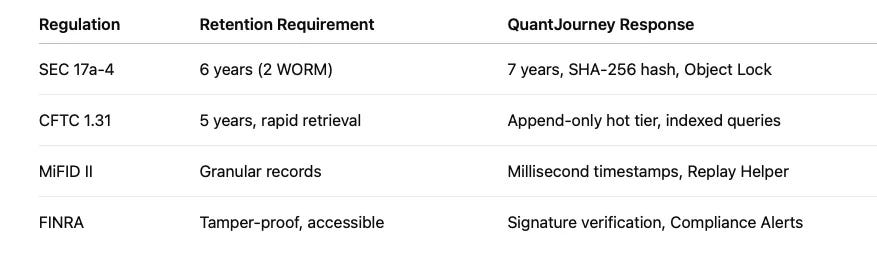
SEC Rule 17a‑4 (United States)
What it demands - Broker‑dealers must keep trade, order, and communication records for at least six years. The first two years must remain in an easily accessible, non‑rewriteable, non‑erasable (WORM) format.
How AuditService answers - Events default to a seven‑year retention window. Each record is hashed with SHA‑256 at write‑time, and optional S3 Object Lock provides hardware‑level WORM storage. Export functions generate regulator‑friendly CSV or JSON bundles on demand.
CFTC Rule 1.31 (United States)
What it demands - Futures and commodities firms must preserve records for five years while ensuring indexing and rapid retrieval.
How AuditService answers - A write‑once, append‑only collection forms the hot tier. Secondary indexes on
timestamp,trade_id, andevent_typekeep typical queries under 50 ms for the most recent two‑year slice. Older data rolls to an archive but remains searchable.
MiFID II (European Union)
What it demands - Investment firms must store granular details—down to the nanosecond—on every order, trade, and algorithmic decision, and reconstruct them within 72 hours.
How AuditService answers - Millisecond timestamps (plus optional ClockSync add‑on for sub‑microsecond precision) combined with a rich event schema (venue, instrument, algorithm_id) allow exact timeline replay. A dedicated
replay()helper streams the ordered event list straight into your staging environment for post‑mortem analysis.
FINRA Books & Records (United States)
What it demands - Broker‑dealers must demonstrate that records are tamper‑proof and readily producible.
How AuditService answers - Signature verification runs during every query. A mismatch triggers a
ComplianceViolationthat doubles as a Prometheus alert and Slack notification, letting compliance teams act before an examiner notices.
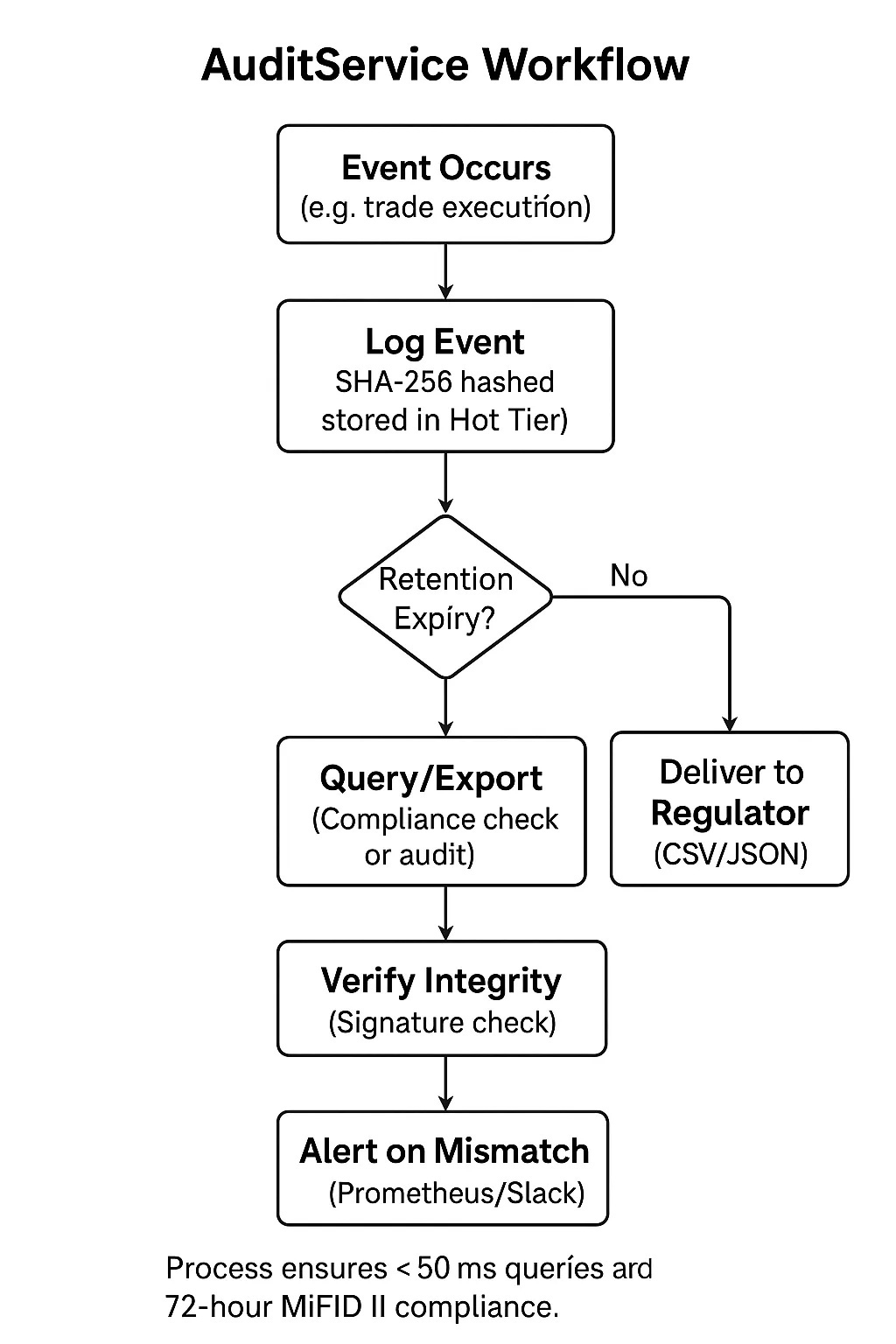
Audit Process Flowchart
To further clarify how AuditService operates, the following flowchart depicts the end-to-end audit logging and retrieval process:
Inside the Data Model
Every audit event is a JSON document; below is a canonical example (comments trimmed for brevity):
{
  "_id": "927fea5bf4f54e02a8b4b0c0566f2d59",
  "timestamp": "2025‑04‑24T10:15:42Z",
  "event_type": "trade_execution",
  "user_id": "usr_A1B2C3",
  "actor": "OMS",
  "trade_id": "trd_98765",
  "regulatory_flag": ["SEC", "CFTC"],
  "compliance_status": "pending",
  "signature": "ab709…",
  "retention_expiry": "2032‑04‑24T10:15:42Z"
}
Why these fields matter
A canonical JSON serialiser ensures the byte‑for‑byte form is identical everywhere before hashing. No surprises from key‑ordering differences.
retention_expiryis stored with the record, so batch archival jobs can act without re‑computing policy logic.
Storage and Retention Tiers
AuditService uses a three-tier storage system to balance performance, cost, and compliance. The following diagram illustrates this architecture:
Hot tier – A capped MongoDB collection keeps the most recent ~30 GiB (about two years of typical trading activity) in ultra‑fast storage.
Warm tier – Once the cap is reached or the
retention_expirythreshold passes, documents move to a standard collection on cheaper SSDs. They remain queryable through the same API.Cold tier – Planned S3 Glacier Deep Archive with Object Lock provides cost‑efficient, verifiably immutable storage beyond seven years. Retrieval jobs automatically stage requested slices back into warm storage for analysis.
Why not use S3 alone? Interactive investigations need the latest months of data within single-digit milliseconds; object storage cannot meet that latency without significant cache-engineering overhead.
Implementation Highlights
AuditService is implemented in Python using the motor library for asynchronous MongoDB interactions. Below is a simplified version of the log method:
@retry(stop=stop_after_attempt(RETRY_ATTEMPTS), wait=wait_exponential(multiplier=1, min=1, max=10))
async def log(
    self,
    event_type: str,
    user_id: str,
    actor: str = "system",
    details: Optional[Dict[str, Any]] = None,
    trade_id: Optional[str] = None,
    regulatory_flag: Optional[List[str]] = None,
    compliance_status: str = "pending"
) -> None:
    with self._metrics.timer("audit_service", "core", "log", "execution"):
        if not event_type or not user_id:
            raise DataValidationError(message="event_type and user_id are required")
        event = {
            "_id": os.urandom(16).hex(),
            "event_type": event_type,
            "user_id": user_id,
            "timestamp": datetime.utcnow().isoformat(),
            "trade_id": trade_id,
            "regulatory_flag": regulatory_flag or [],
            "signature": self._generate_signature(event),
            "retention_expiry": (datetime.utcnow() + timedelta(days=365 * DEFAULT_RETENTION_YEARS)).isoformat()
        }
        await self._coll.insert_one(event)
        await self._metrics.increment_counter("audit_service", "core", "event", "log_success")
This method validates inputs, generates a tamper-proof signature, and logs the event with retries, ensuring reliability even under high load.
Other frequently used methods:
query()– Fetches events matching a date range,trade_id, or any field in the schema. Paginates withlimit/aftercursors for resiliency.export()– Streams CSV or JSON to S3, local disk, or directly into a provided file‑like object—handy for one‑click regulator packages.verify()– Recomputes hashes over a slice of data and raises on a single mismatch, suitable for nightly integrity jobs.
Observability and Alerting
AuditService instruments every operation with two primitives: counters and duration timers. These feed a default Prometheus registry; a Grafana dashboard ships in the /deployment/grafana folder.
Key signals to watch:
audit_log_success_totalvs.audit_log_failed_total– A sudden divergence often points to database latency or schema‑validation problems.audit_signature_mismatch_total– Non‑zero values should trigger an immediate compliance review.audit_latency_seconds(histogram) – Keep the 95th percentile below 250 ms for smooth UI performance in downstream tools.
Future Work
Object‑Lock WORM on AWS S3 – Currently in development for Q2 2025.
HMAC‑SHA256 with Vault‑managed keys – Adds key rotation and salt‑per‑tenant; scheduled for Q3 2025.
Self‑serve e‑Discovery UI – Allows compliance officers to run ad‑hoc searches and exports without developer intervention; slated for Q4 2025.
Getting Started in Four Steps
Install QuantJourney B2B Framework ≥ v1.6.0.
Enable the feature flag:
[features]
audit_service = true
Configure retention and hot‑tier size:
[audit_service]
retention_years = 7   # must be ≥ regulator minimum
hot_tier_gb     = 30  # set per tenant workload
Write your first event:
audit_id = await audit.log(
    event_type="trade_execution",
    user_id="usr_demo",
    trade_id="T123"
)
print(f"logged event {audit_id}")